Police Physical Test in Quebec: ENPQ and CEGEP Tests
Quebec's police physical test, the ESAP, must be finished in 5 min 22 s or less. Stations, 12-week plan, retakes and CEGEP tests.
· By the Agent Policier editorial team · Lire en français
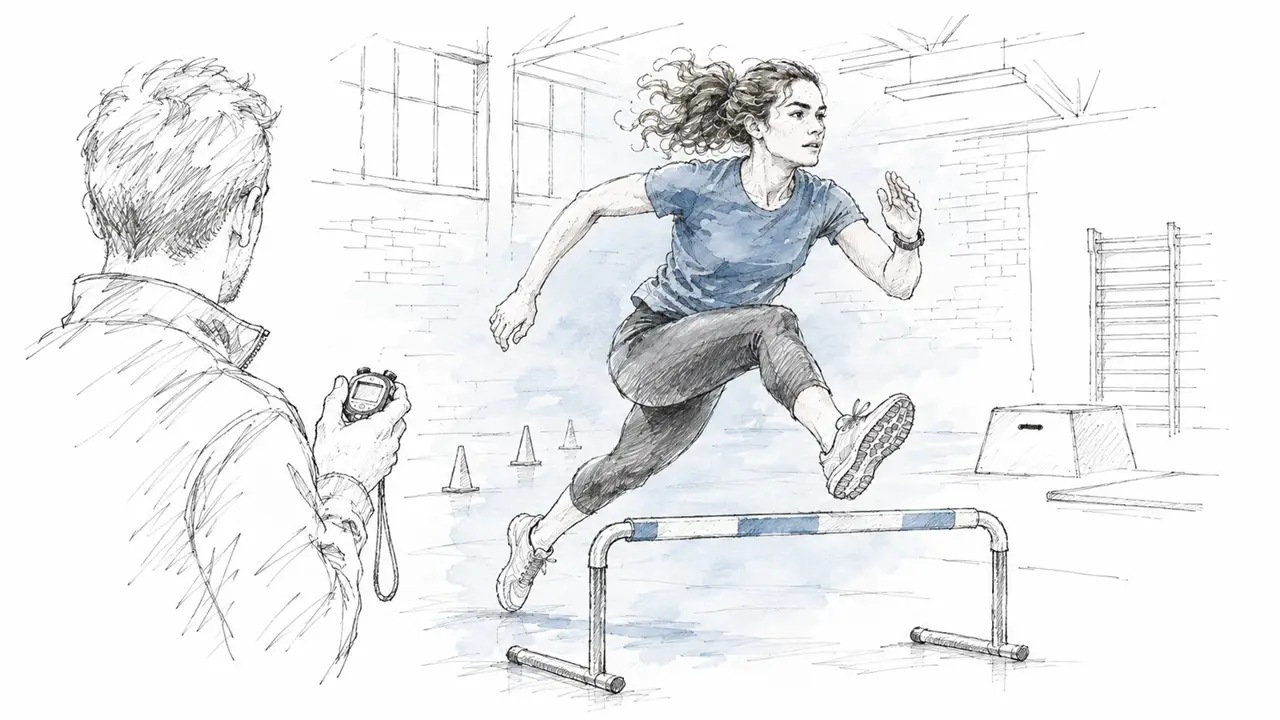
The police physical test in Quebec is the ESAP, a circuit you must finish in 5 minutes 22 seconds or less, according to the presentation by the École nationale de police du Québec (Quebec's police academy) dated February 24, 2022. It costs $152 in 2026-2027 and is part of the admission process described on our ENPQ page. This text applies to women and men police officers alike.
The ESAP in brief
The full name is épreuve standardisée d'aptitudes physiques (standardized physical abilities test), or ESAP-ENPQ Police 2017. The circuit has three laps.
It mainly calls on muscular power and the aerobic system. It also requires quick decision-making.
The candidate wears a 2.27 kg weighted vest and a 4.54 kg weighted belt, or 6.8 kg according to the École.
The timer stays hidden and watches are forbidden in the gym. Evaluators direct the candidate from one station to the next. The candidate therefore does not have to memorize the course.
A fault triggers the command "Recommencez!" (start over). The candidate then returns to the start of the station and repeats it until it is done correctly. The candidate can ask to stop the test at any time.
The circuit stations
| Station | What the ENPQ requires |
|---|---|
| Light targets (cibles lumières) | Spot the green target, step back onto the correct mat within 3 seconds and aim at it for at least 1 second with a flashlight |
| Jump | Clear 1.8 m after a run-up in a 9 m corridor, with no more than 4 attempts per lap |
| Moving through a crowd | Pass through the centre of the punching bags by pushing them aside |
| Lateral movements | Go around silhouettes using side steps |
| Stairs | Go up, then down |
| Wire mesh wall | Get over the wall without help |
| Pushes (lap 1) | 3 pushes of a 38.5 kg load |
| Pulls (lap 2) | 3 pulls of a 38.5 kg load |
| Low walls | Go over the three low walls |
| Modified T-test | Run a 9 m corridor, swap balls on cones, then come back moving backward |
| Victim drag (lap 3) | Move a 67.5 kg mannequin over 10 m without its head touching the ground |
Source: ENPQ, Présentation de l'ESAP-ENPQ Police 2017, February 24, 2022. The timer stops when the final light targets station is passed.
Preparing with the ENPQ plan
The École publishes a 12-week preparatory training plan. It presents the plan as a proposal. A certified training professional can adapt it.
- Initial phase: 6 weeks, 3 days a week
- Progressive phase: 6 weeks, 3 days a week, building toward explosive movements
- Three components: muscular power, agility and coordination, interval running
A second plan targets the light targets station, done three times during the circuit at different levels of fatigue. It works on coordination, reaction time, dual tasks and peripheral vision. The École recommends adding the 6.8 kg load once the exercises are mastered.
Before the test
The ENPQ presentation gives these instructions.
- Wear sports clothing and bring a towel and a water bottle
- Leave 2 hours between a regular meal and the evaluation. A light snack is suggested during that time
- Eat before you arrive if the evaluation is early in the morning
- Avoid caffeine and smoking in the 2 hours before
- Avoid alcohol and exercise in the 6 hours before
- Avoid any intense training in the 24 hours before
- Take your medication as prescribed
The École's page forbids energy drinks before the ESAP. The candidate must arrive without injury, without a brace and without protective gear.
If a health problem occurs during the test, the candidate tells the instructor and sees the École's medical staff before leaving. A medical certificate is required to retake the test.
Failure, retakes and validity
A candidate who fails is entitled to two retakes per application for admission. The retake takes place at the next session on the school calendar.
The ESAP is valid for 12 months from the date it is passed for admission to the École. The Sûreté du Québec (Quebec's provincial police) writes that a passed test is valid for 2 years for its recruitment and that it grants no equivalency.
CEGEP physical tests
The ESAP comes after the DEC (college diploma). To enter the DEC, each CEGEP has its own test. Collège Ahuntsic and Cégep Garneau have candidates run for 12 minutes on a 100 m track.
At Ahuntsic, the threshold is 2,700 m for boys and 2,300 m for girls. At Garneau, these distances earn the maximum points and the minimum is 20 laps for boys and 16 for girls.
Cégep de la Gaspésie et des Îles uses four tests. Our page on Police Technology compares the 15 institutions.
The RCMP test is different. It is described on our page about training at Depot Division.
This text summarizes public documents. It is not medical advice. See a health professional before starting intense training.
Did you like this article?
Thank you. It is anonymous, and it tells us what to write next.
← Back to Agent Québec, all six professions
Frequently asked questions
What are the physical tests to become a police officer?
In Quebec, the École nationale de police requires the ESAP, a timed circuit of three laps. CEGEPs also have their own tests for admission to the DEC. The RCMP uses a different test.
What time do you need on the ESAP?
The circuit must be finished in 322 seconds or less, or 5 minutes 22 seconds. The candidate cannot see the timer during the course. Evaluators cannot say how much time remains.
How much does the police physical test cost?
The ESAP costs $152 from July 1, 2026 to June 30, 2027, according to the ENPQ fees page. The fee is payable when the invitation is received. The École specifies that its fees may change.
How many times can you retake the physical test?
The ENPQ grants two retakes per application for admission. The retake takes place at the next session on the school calendar. An injury during the test does not count as a failure, unless the symptoms are linked to a pre-existing condition.
How do you prepare for the police physical test?
The ENPQ publishes a 12-week preparatory plan, at 3 days a week. It also publishes a plan for the light targets station. Both plans can be downloaded from its ESAP page.
How long is the physical test valid?
The ENPQ recognizes it for 12 months from the date it is passed for its admission. The Sûreté du Québec writes that it is valid for 2 years for its recruitment. Each organization applies its own period.
Did you like this article?
Thank you. It is anonymous, and it tells us what to write next.
← Back to Agent Québec, all six professions
Sources
- École nationale de police du Québec, Présentation de l'ESAP-ENPQ Police 2017, February 24, 2022, consulted on November 22, 2026
- École nationale de police du Québec, Plan d'entraînement préparatoire à l'ESAP-ENPQ Police 2017, February 27, 2017, consulted on November 22, 2026
- École nationale de police du Québec, Plan d'entraînement spécifique pour la station des cibles lumières, April 19, 2018, consulted on November 22, 2026
- École nationale de police du Québec, Étape 6, Effectuer l'ESAP-ENPQ Police 2017, page modified on March 10, 2022, consulted on November 22, 2026
- École nationale de police du Québec, Frais 2026-2027, rates from July 1, 2026 to June 30, 2027, consulted on November 22, 2026
- Sûreté du Québec, Recrutement policier, consulted on November 22, 2026
- Collège Ahuntsic, Techniques policières, Coûts et conditions d'admission, consulted on November 22, 2026
- Cégep Garneau, Techniques policières, consulted on November 22, 2026
- Cégep de la Gaspésie et des Îles, Techniques policières, consulted on November 22, 2026